How to Manage a Personal Injury Case From Intake to Settlement
A personal injury case can involve months or even years of work across attorneys, paralegals, clients, medical providers, insurance companies, and other parties. From the first intake conversation to the final settlement, every stage creates information, documents, deadlines, tasks, and decisions that need to be managed.
For plaintiff law firms, a consistent case workflow helps ensure that important information does not become scattered across emails, spreadsheets, calendars, folders, and disconnected systems.

A well-managed personal injury case should have a clear path from intake to settlement, with each stage building on the information collected during the previous stage.
1. Start With a Structured Client Intake
The case-management process begins before a case is formally accepted.
During intake, the firm may collect information about the client, accident, injuries, medical treatment, insurance coverage, opposing parties, witnesses, employment, and other relevant circumstances.
A structured intake process allows the firm to capture this information consistently and determine whether the potential claim fits the firm's practice and acceptance criteria.
Once a case is accepted, information collected during intake should become part of the permanent case record rather than being entered again manually.
2. Build the Case Record
After intake, the legal team needs a centralized case record containing the core information about the matter.
This may include:
Client and contact information
Accident or incident details
Defendant information
Insurance policies
Witnesses
Injury information
Attorneys and assigned staff
Important dates
Case documents
Initial notes and communications
A complete case record gives everyone working on the matter a common source of information.
3. Investigate the Claim and Liability
The next stage is understanding what happened and developing the factual basis of the claim.
Depending on the case, this may involve accident reports, photographs, witness statements, insurance information, correspondence, employment records, and other evidence.
The firm should track outstanding investigation tasks and identify missing information rather than relying on individual staff members to remember what still needs to be obtained.
A case-management workflow can help assign these tasks, establish deadlines, and provide visibility into their status.
4. Track Medical Treatment
Medical treatment is one of the most important ongoing components of many personal injury cases.
Clients may visit emergency departments, primary-care physicians, specialists, physical therapists, imaging facilities, surgeons, and other providers.
The firm may need to track:
Medical providers
Treatment dates
Diagnoses
Procedures
Imaging and reports
Medical bills
Records received
Outstanding records
Treatment status
Instead of keeping medical information as disconnected documents, firms can organize it into a chronological record.

A medical chronology can help the legal team understand the progression from the accident through diagnosis, treatment, recovery, and ongoing care.
5. Monitor Deadlines and Statutes of Limitations
Every case has important dates that need to be monitored.
Depending on the jurisdiction and circumstances, these may include statutes of limitations, filing deadlines, discovery-related dates, medical follow-ups, insurance deadlines, and internal task deadlines.
A reliable case-management process should make these dates visible to the appropriate members of the team.
Automated reminders and scheduled tasks can reduce dependence on manual calendar entries and help firms identify approaching deadlines earlier.
6. Document Damages
As the case develops, the firm should build a complete picture of the client's damages.
Economic damages may include medical expenses, lost wages, property damage, and other documented financial losses. The case may also involve non-economic damages associated with the client's injuries and their effects.
Supporting documentation should be linked to the appropriate case so that the legal team can review the damages before preparing a demand.
This stage is particularly important because missing documentation can make it harder to establish the full value and impact of a claim.
7. Organize Documents and Communications
Personal injury cases can generate a significant volume of documents and communication.
Medical records, bills, correspondence, insurance documents, photographs, authorizations, demand materials, settlement documents, and other files should have a predictable organizational structure.
Important client communications should also remain accessible to authorized members of the team.
A centralized system can reduce the time spent searching through email threads and shared folders for the latest version of a document or the history of a conversation.
8. Prepare the Settlement Demand
Once treatment, records, damages, and supporting evidence have been sufficiently developed, the firm may prepare a settlement demand.
The demand process typically requires the legal team to bring together information collected throughout the case.
This may include:
Liability + Medical Treatment + Damages + Supporting Documentation + Client Impact
Because these components have been collected throughout the case, preparing the demand becomes a matter of assembling and reviewing established case information rather than reconstructing the file from multiple sources.
9. Track Negotiations
Settlement negotiations can involve multiple demands, offers, counteroffers, communications, and changes in strategy.
Each significant negotiation event should be recorded against the case.
Maintaining a clear negotiation history allows attorneys and staff to understand how the matter has progressed and what has previously been communicated.
This becomes particularly valuable when multiple team members are working on the same case.
10. Manage the Settlement and Closing Process
When a settlement is reached, the case moves into another important operational phase.
The firm may need to manage settlement documentation, attorney fees, case expenses, medical liens, other deductions, client distribution, trust or operating account activity, and closing requirements.
The settlement workflow should therefore be treated as more than simply recording the final settlement amount.
A structured process can help the firm track the financial components of the settlement and verify that required steps have been completed before the case is closed.
From Intake to Settlement: One Connected Workflow
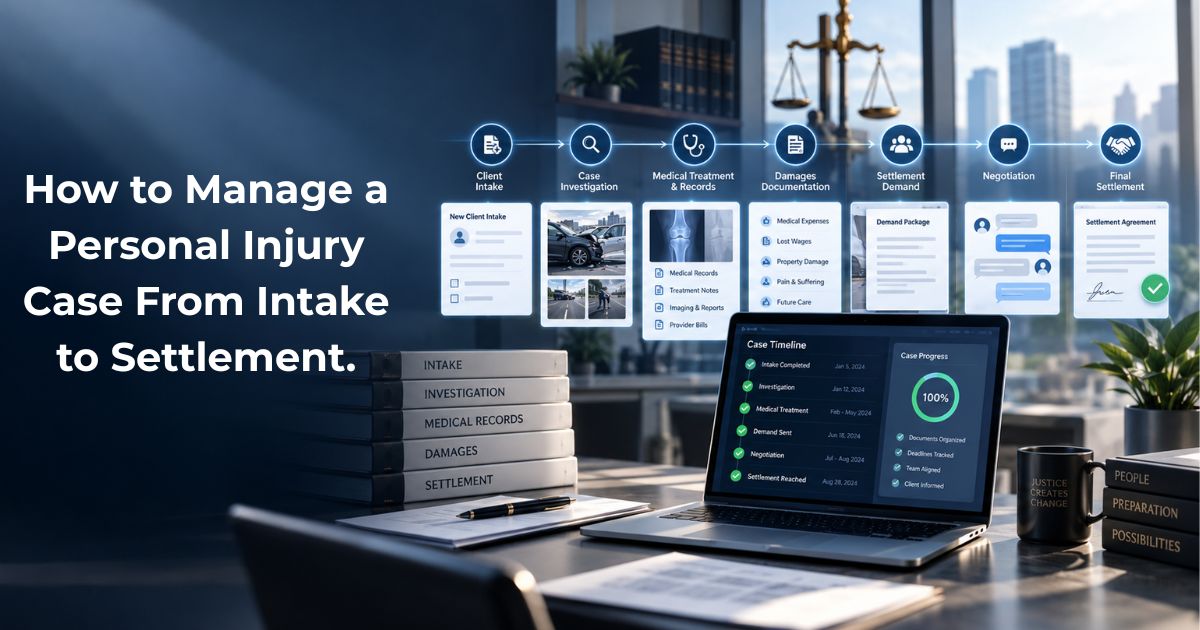
The most effective approach is to treat the case as one continuous workflow rather than a collection of independent activities.
A typical personal injury workflow can look like:
Intake → Case Acceptance → Investigation → Treatment → Medical Chronology → Damages → Demand → Negotiation → Settlement → Closing
Each stage depends on information collected earlier.
When these stages are connected, the team can move from one phase to the next without repeatedly searching for information or recreating records.
Why a Standardized Workflow Matters
Every attorney and paralegal may have their own preferred way of managing a case. Without standardized processes, however, different cases can be handled differently, making it harder for a growing firm to maintain consistency.
A standardized workflow establishes:
What information should be collected
Which tasks belong to each stage
Who is responsible for each activity
Which deadlines need monitoring
Which documents are required
When a case can move to the next stage
What needs to happen before closing
This creates operational consistency while still allowing attorneys to exercise professional judgment over individual cases.
Final Thoughts
Managing a personal injury case from intake to settlement requires coordination across people, information, documents, deadlines, medical records, damages, negotiations, and financial details.
The objective of case management is not simply to store all of this information. It is to connect the information to the workflow of the case.
When intake, investigation, medical treatment, damages, deadlines, demands, negotiations, and settlement activities are managed as one connected process, legal teams can spend less time searching for information and more time working on the case.
For growing plaintiff law firms, establishing this connected workflow can provide a more consistent foundation for managing cases at scale.