L E X T I F F

Loading

Plaintiff case management software built exclusively for personal injury and contingency law firms.

Security & Compliance

Lextiff Security Dashboard
Security, Compliance & Audit

Built-in controls for protecting sensitive case information.

Lextiff gives plaintiff firms granular access controls, audit trails, security settings, and compliance workflows to help protect case information and maintain accountability across the firm.

๐Ÿ—„๏ธ
15 min
Backup frequency
โฑ๏ธ
PITR
Point-in-time recovery
๐Ÿ”’
TLS 1.2/1.3
Encrypted in transit
๐Ÿงพ
SHA-256
Backup integrity verified
๐Ÿข
Multi-tenant
Firm-level isolation
๐Ÿ‘ค
RBAC
Role-based access control
๐Ÿ“‹
Audit logs
Every action traceable
๐Ÿ›Ÿ
DR plan
Documented recovery process
Security

Security Controls Built Into the Platform

Security in Lextiff isn't limited to infrastructure. Firm administrators can configure how users access information, how sensitive actions are governed, and how activity is recorded throughout the platform.

Roles & Permissions

Control access based on user roles and responsibilities.

Audit Logging

Track important activity with user, timestamp, and access information.

Compliance Controls

Configure firm-level rules for approvals, case lifecycle, time tracking, and governance.

Account Security

Protect accounts with verification, MFA, trusted devices, and security controls.

ROLES & PERMISSIONS

Access Control That Fits Your Firm

Not every member of a plaintiff firm needs access to the same information or actions. Lextiff lets administrators define roles and permissions around how work is actually performed.

Key Capabilities:

โœ“ Role-Based Access (RBAC)
โœ“ Granular permissions
โœ“ User responsibilities
โœ“ Administrative control
โœ“ Restricted access where appropriate
Compliance

Security & Compliance, Without the Marketing Badges

We distinguish between controls currently implemented in the platform and formal certifications or attestations. When Lextiff obtains a formal certification or third-party attestation, we will publish it here. Lextiff provides firm-level controls for governing how important activities are handled, reviewed, and recorded.

Currently implemented

โœ“ Role-Based Access Control (RBAC)
โœ“ Audit & Retention
โœ“ Time & Billing Controls
โœ“ Account security controls
โœ“ Compliance configuration
โœ“ Financial governance
โœ“ Settlement approval controls
โœ“ Case lifecycle controls

Lextiff is designed to support these standards โ€” this page describes our architecture and practices, and does not constitute a certification. Formal certifications, where pursued, will be announced separately.

AUDIT LOG

Know What Happened. Who Did It. And When.

Lextiff records important activity so authorized administrators can review access and operational events across the platform. Important platform activity is recorded with user and timestamp information for accountability and review.
User โ†’ Action โ†’ Record โ†’ Timestamp โ†’ IP Address

Potential examples:

โœ“ Login activity
โœ“ Record access
โœ“ User actions
โœ“ Administrative activity
โœ“ Security events
ACCOUNT SECURITY

Account Security & Verification

Protect individual user accounts with additional verification and device-level security controls.

Potential examples:

โœ“ Multi-Factor Authentication: Additional verification for account security.
โœ“ Trusted Devices: Review and manage recognized devices.
โœ“ Account Verification: Verification controls for sensitive account changes.
ENCRYPTION & ACCESS

Data Protection & Account Security

Security in Lextiff isn't limited to infrastructure. Firm administrators can configure how users access information, how sensitive actions are governed, and how activity is recorded throughout the platform.

Potential points:

โœ“ Encryption in transit
โœ“ Encryption at rest
โœ“ Secure document storage
โœ“ Protected backups
โœ“ Role-based access
โœ“ MFA
โœ“ Session controls
โœ“ Trusted devices
โœ“ Account verification
Infrastructure

Built on Modern Cloud Infrastructure

Lextiff uses cloud infrastructure and managed storage services to support application availability, data protection, and recovery.
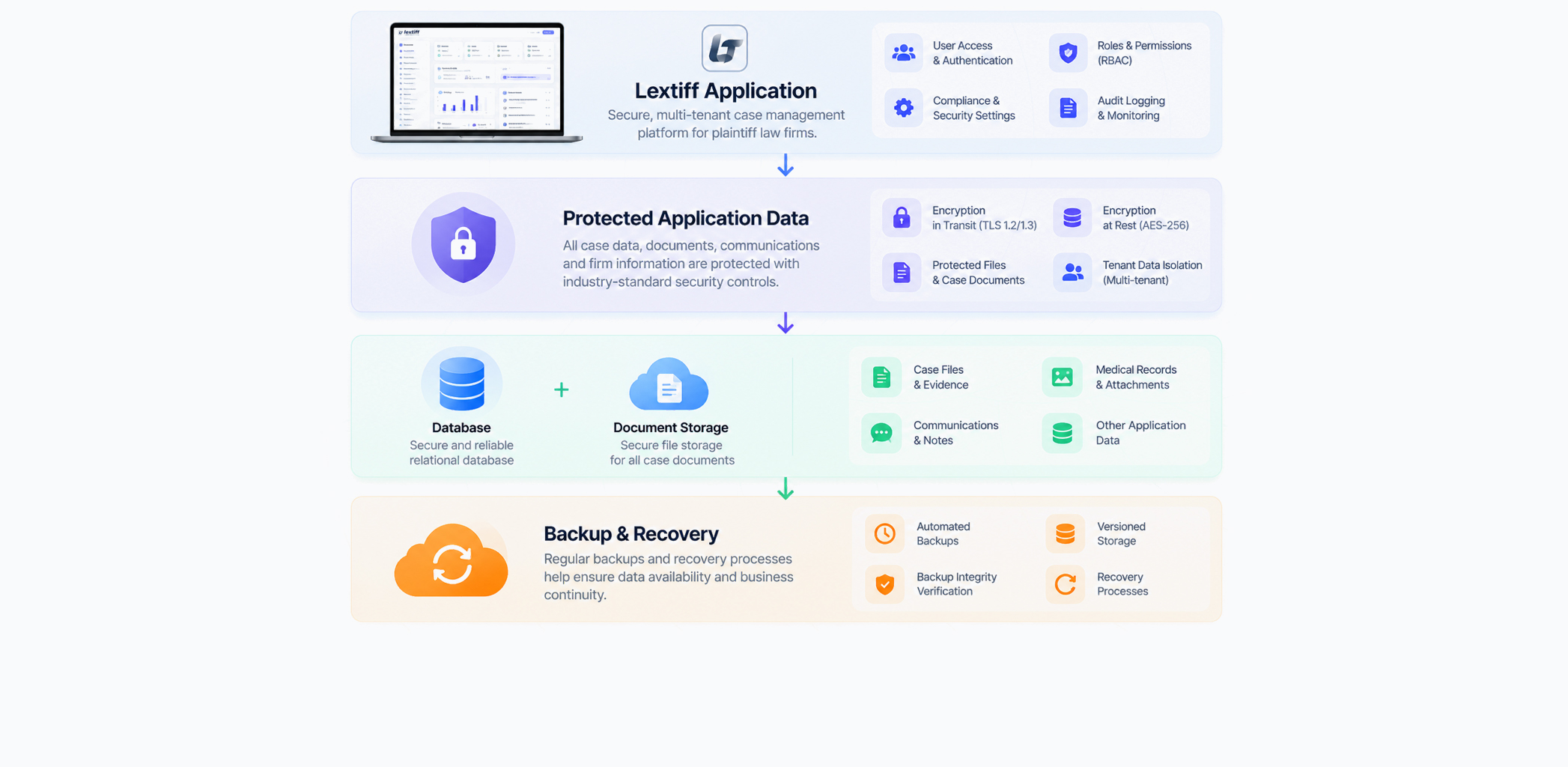
Lextiff Security
Ownership & Privacy

Your firm's data stays under your control.

Case information, documents, notes, communications, and other customer content belong to the customer. Lextiff provides the platform used to store and manage that information.

โœ“ Privacy controls
โœ“ Data export available
โœ“ Account management
โœ“ No sale of customer data

Your data belongs to you.

Every case, document, note, message, and uploaded file you enter into Lextiff is yours. We are the platform โ€” not the owner.

What we never do:

โœ— Sell customer data
โœ— Advertise using case information
โœ— Share data with unauthorized third parties
โœ— Claim ownership of uploaded content
Operational Security

Operational Security

Security doesn't stop when a user logs in. Lextiff maintains operational processes for monitoring, backups, recovery, and incident handling.

๐Ÿšจ

Incident Response

Defined procedures for investigating and responding to security events.

๐Ÿ›Ÿ

Recovery

Processes for restoring services and data.

๐Ÿ“ก

Monitoring

Platform and security event monitoring.

๐Ÿ’พ

Backups

Regular database and document backup processes.

Continuous monitoring

We watch the platform, so problems get caught early.

We continuously monitor our platform for:

โœ“ Infrastructure health
โœ“ Backup verification
โœ“ Integrity monitoring
โœ“ Application & audit logging
โœ“ Authentication anomalies
โœ“ Scheduled recovery testing
Responsible disclosure

Found a vulnerability?

We take security reports seriously and appreciate researchers who help us keep the platform safe. If you believe you've found a security issue, please let us know.

security@lextiff.com
Shared responsibility

Security is shared.

Lextiff provides the platform, controls, and infrastructure. Your firm is responsible for how the system is used day to day.

Lextiff is software โ€” not legal advice. Users remain solely responsible for verifying deadlines, calculations, filings, and all legal obligations applicable to their practice.

Lextiff's Responsibilities

โœ“ Platform security, encryption, and access controls
โœ“ Backups, monitoring, and disaster recovery
โœ“ Vulnerability response and patching
โœ“ Infrastructure uptime and maintenance

Customer Responsibilities

โœ“ Protecting account credentials
โœ“ Restricting access to authorized personnel
โœ“ Verifying deadlines and legal obligations
โœ“ Reporting suspected security issues promptly
Security FAQ

Common questions from IT & security reviewers.

Lextiff uses role-based access controls (RBAC) so firms can assign permissions according to each user responsibilities. Roles can be configured for attorneys, paralegals, intake staff, case managers, accounting users, and other members of the firm.

Yes. Lextiff provides configurable roles and permissions so administrators can control access according to a user role and responsibilities. This allows firms to avoid giving every team member the same level of access.

Yes. Lextiff includes an Audit Log that records important platform activity, including user activity and access events. Administrators can review activity, filter records, and export audit information when needed.

Lextiff provides additional account-verification controls, including email verification, two-factor authentication, and trusted-device management. These controls help firms add an additional layer of protection to user accounts.

Yes. Lextiff includes a dedicated Compliance configuration area where administrators can manage controls related to time approval, time editing, time rounding, case lifecycle rules, settlement approval, financial governance, audit logging, and log retention.

Yes. Lextiff includes settlement approval controls that allow firms to incorporate approval requirements into their settlement workflow.

Lextiff uses multiple layers of controls, including role-based access, account security, audit logging, encryption, secure storage, and backup/recovery processes. The platform is designed to give firms control over who can access information and provide accountability for important activity. For the specific encryption technologies and infrastructure details, Lextiff documents the applicable controls separately in its security and privacy resources.

Yes. Lextiff maintains database backup and recovery processes designed to help protect against data loss and support restoration when required. The platform also uses versioned storage and recovery mechanisms.

Lextiff operates as a multi-tenant platform with firm-level data isolation. Access controls are applied within each firm environment so users are restricted to the information they are authorized to access.

Lextiff should distinguish between security controls implemented within the platform and formal third-party certifications or attestations. The presence of security controls does not itself constitute SOC 2, ISO 27001, or another certification. Formal certifications or attestations should only be reported as current once they have actually been obtained.

Lextiff is designed with security and privacy controls intended to support the handling of sensitive information. Where HIPAA-covered use cases apply, firms should review the applicable safeguards, contractual requirements, and BAA arrangements with Lextiff before using the platform for regulated data.

Lextiff provides links to its Privacy Policy, Terms of Service, Cookie Policy, DPA, Acceptable Use Policy, and Subprocessor information. Firms that need additional security information can contact the Lextiff team for further details.

Security issues can be reported to: security@lextiff.com. Lextiff asks security researchers and users to report vulnerabilities responsibly and allow reasonable time for investigation and response before publicly disclosing an issue.
Trust resources

Security documents & downloads.

Lextiff is engineered with layered security controls, privacy-focused design, and modern cloud infrastructure to help law firms protect client information and operate with confidence.

Operated by Canvas Chrome Designs ยท Last security review: August 2026