
Managing the financial side of a personal injury case involves more than recording the final settlement amount. Law firms may need to account for medical liens, provider balances, case expenses, attorney fees, settlement deductions, and the amount ultimately payable to the client.
These figures often come from different sources and may change throughout the case. Medical providers can submit bills, litigation expenses can accumulate, and lien balances may require verification or negotiation before settlement funds are distributed.
Without a consistent process, financial information can become scattered across spreadsheets, invoices, correspondence, accounting records, and case files. A structured workflow helps firms maintain visibility into these obligations and prepare more accurate settlement reconciliations.
1. Understand the Difference Between Liens, Expenses, and Disbursements
Although these financial items are connected, they serve different purposes.
Liens and reimbursement claims may represent amounts asserted by healthcare providers, health plans, government programs, or other parties seeking payment from a settlement. Their validity, priority, and amount depend on the applicable law and circumstances.
Case expenses are costs incurred while investigating, pursuing, or resolving a matter. Examples may include filing fees, records retrieval, deposition costs, expert fees, and other case-related expenditures.
Client disbursements are payments made from settlement proceeds after the applicable deductions and obligations have been determined.
Separating these categories helps the firm understand what is owed, what has been spent, and what remains payable.
2. Record Case Expenses as They Occur
Case expenses should be recorded throughout the life of the matter rather than reconstructed when settlement is imminent.
For each expense, the firm can record:
Expense category
Date incurred
Vendor or service provider
Amount
Invoice or receipt
Payment status
Related case
Responsible staff member
A centralized expense record reduces the need to search through invoices and email threads when preparing the final settlement statement.
It also helps the firm identify outstanding costs that must be considered before the case is closed.
3. Maintain a Separate Record for Each Lien
A single personal injury case may involve several lienholders or reimbursement claims. Each should have its own record linked to the relevant case.
Useful fields may include the lienholder's name, claim reference, contact details, asserted amount, verified balance, supporting correspondence, negotiation status, and resolution status.
The firm should distinguish between an initially asserted amount and the amount ultimately verified or agreed upon. These figures are not necessarily identical.
Maintaining a separate record for each obligation makes it easier to identify unresolved claims and prevents different lienholders' information from becoming mixed together.
4. Verify Balances Before Settlement Distribution
An amount recorded months earlier may no longer represent the current balance.
Before disbursing settlement funds, the legal team should verify the relevant balances, review supporting documentation, confirm any negotiated reductions, and identify outstanding obligations.
Depending on the case, this may involve contacting providers, reviewing reimbursement claims, confirming payment instructions, and obtaining necessary approvals.
The firm should also evaluate applicable legal requirements and any obligations governing the handling of settlement proceeds.
5. Track Lien Negotiations and Reductions
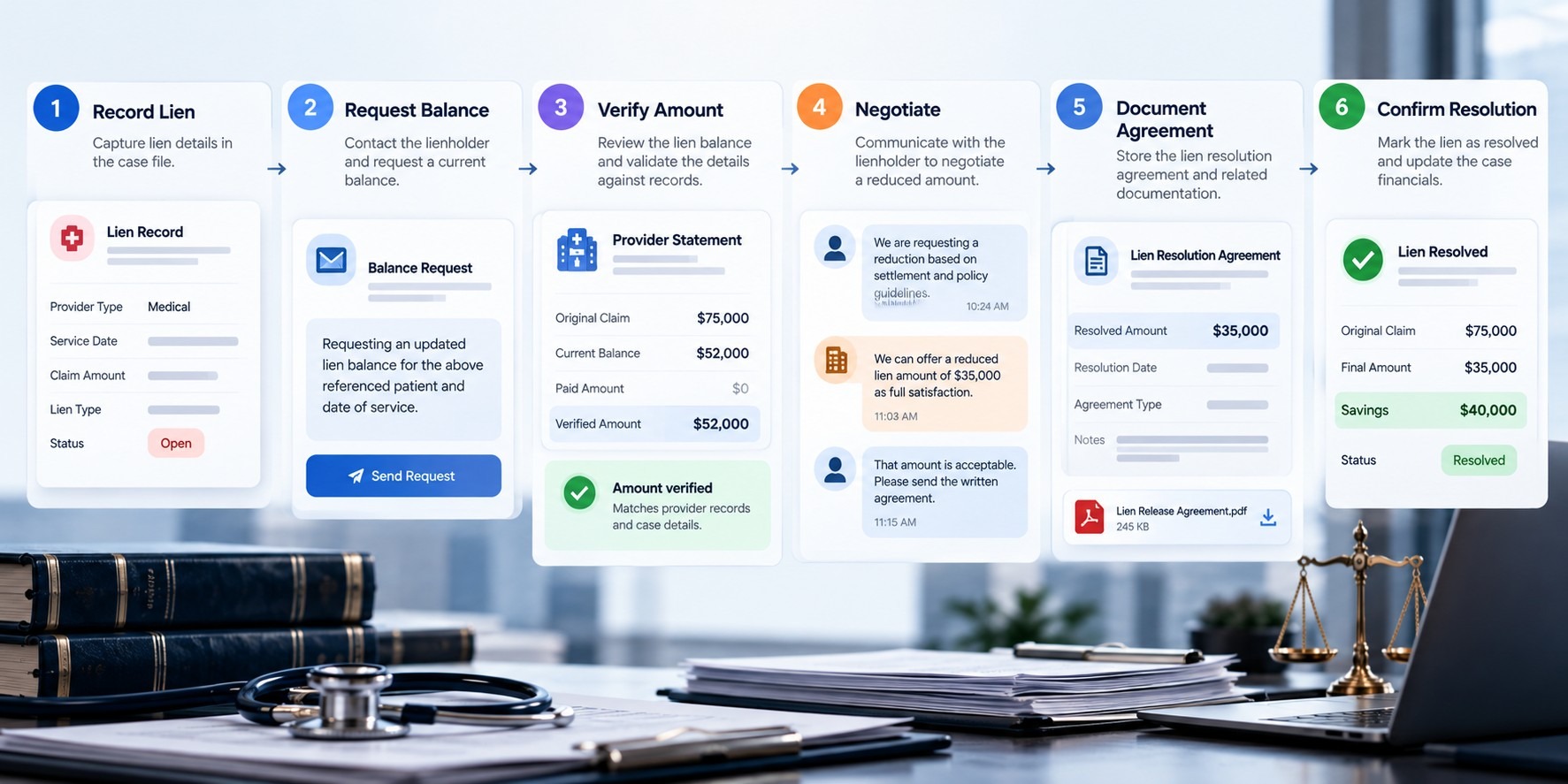
Lien resolution can involve correspondence, requests for reductions, counterproposals, updated balances, and agreements.
A useful workflow should record the original amount, each significant negotiation event, the revised amount, supporting documents, and the final resolution.
This creates a clear history of how an obligation changed over time.
Keeping that history connected to the case also helps authorized team members understand the current position without reconstructing the negotiation from individual email inboxes.
6. Calculate the Settlement Distribution
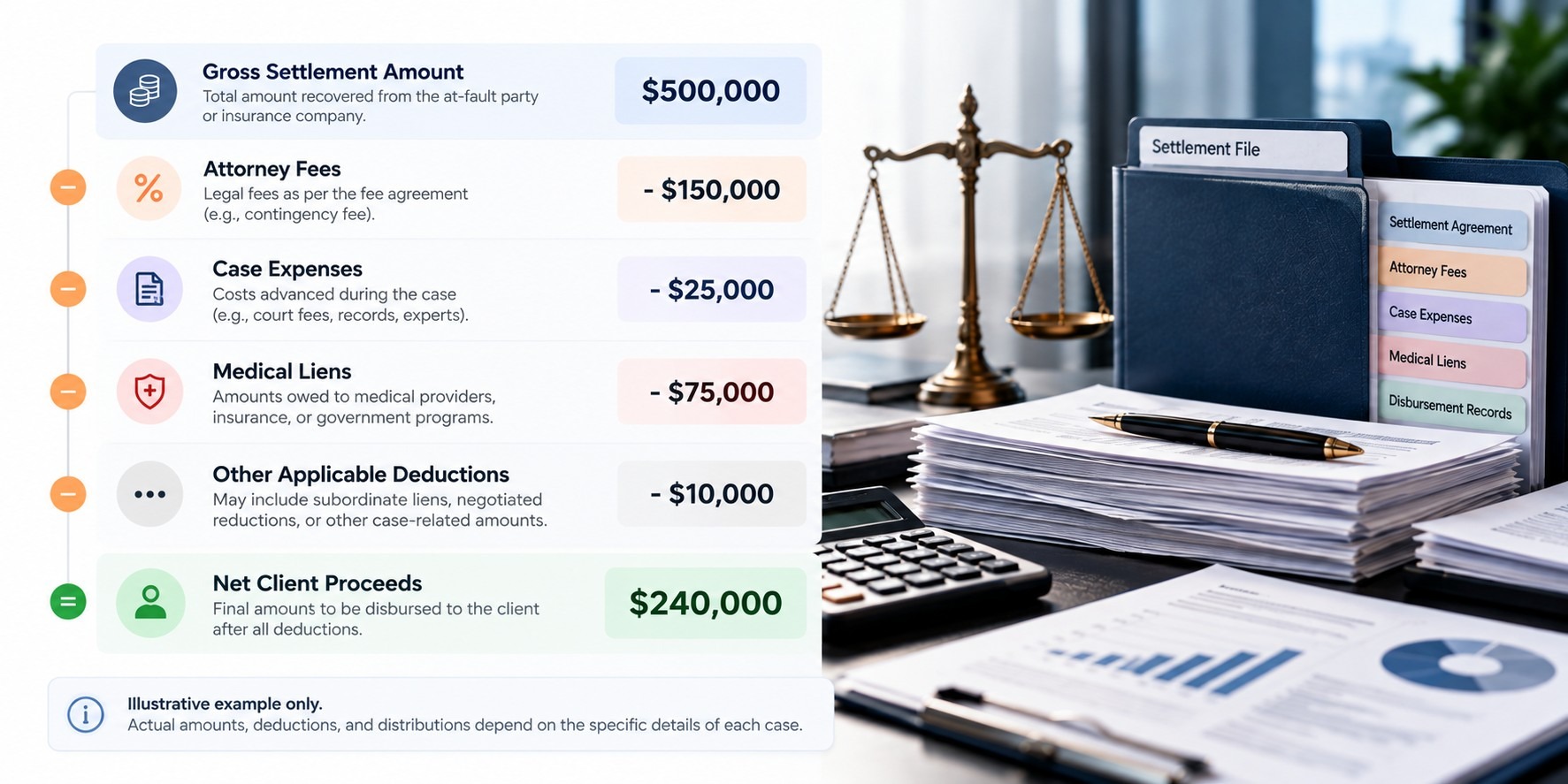
Once the settlement amount and applicable deductions have been established, the firm can prepare a settlement reconciliation.
Depending on the fee agreement and case circumstances, the calculation may account for:
Gross settlement amount
Attorney fees
Case expenses
Medical liens and reimbursement obligations
Other authorized deductions
Net amount payable to the client
The calculation should reflect the actual agreement, applicable law, verified obligations, and any required approvals. Deductions should not be assumed to follow one universal formula.
A documented settlement statement helps the firm explain how the final client disbursement was determined.
7. Keep Settlement Records Connected to Accounting
A case-management record should not replace the firm's accounting system or trust-account controls.
Instead, case-management workflows can help organize settlement information and supporting documents while the firm's accounting procedures handle the appropriate financial records, reconciliations, and payments.
Firms should maintain clear distinctions between recording a planned payment, approving a payment, issuing it, and confirming that it has cleared.
This distinction is particularly important where client funds are held in a trust account and applicable professional rules impose specific handling and reconciliation requirements.
8. Establish Clear Approval and Disbursement Procedures
Before settlement proceeds are distributed, the firm should follow a defined review process.
Depending on its policies and applicable requirements, this may include confirming receipt of funds, verifying deductions, resolving outstanding obligations, preparing the settlement statement, obtaining required approvals, issuing authorized payments, and documenting the completed disbursements.
Each step should have a responsible person and a clear status.
A structured approval workflow helps prevent payments from being issued while important balances, documents, or authorizations remain unresolved.
9. Monitor Outstanding Obligations
An approaching settlement can reveal financial issues that were not visible earlier in the case.
For example, a medical provider's final bill may be missing, a lien balance may be disputed, or an expense invoice may remain unpaid.
A dashboard or review report can help the team identify unresolved items before closing the matter.
Useful indicators include outstanding liens, unverified balances, pending negotiations, unpaid expenses, approvals awaiting review, and disbursements that have not been completed.

10. Use Case-Management Software to Improve Financial Visibility
Legal case-management software can help firms connect liens, expenses, settlement calculations, supporting documents, and disbursement tasks to the appropriate case.
Depending on the platform, useful capabilities may include:
Case-level expense tracking
Lienholder records
Balance and negotiation status
Document attachments
Settlement calculations
Deduction summaries
Approval workflows
Payment-status tracking
Settlement reports
Audit history
Firms should verify which functions their chosen platform actually supports and whether separate accounting software is needed for payment processing and financial reconciliation.
Technology can improve visibility and reduce repetitive data entry, but it does not replace legal review, accounting controls, or the verification of amounts owed.
Final Thoughts
Tracking liens, expenses, and client disbursements requires a consistent financial workflow that begins when costs are incurred and continues through settlement and case closure.
The most reliable approach separates each financial obligation, maintains supporting documentation, verifies balances, records negotiations, reconciles settlement deductions, and documents authorized payments.
For personal injury law firms, connecting these records to the case-management process can make settlement preparation more organized and financial obligations easier to monitor. The result is a clearer record of where settlement funds go, why deductions were made, and what remains payable to the client.
Looking for Personal Injury Case Management Software?
Managing medical liens, case expenses, settlement deductions, and client disbursements requires organized financial records and a reliable settlement workflow.
If you are comparing the best personal injury case management software, searching for legal settlement management platforms, or evaluating tools to track medical liens and calculate settlement distributions, look for a solution that connects financial information with the underlying case.
Lextiff is a legal case management platform designed to help law firms organize cases and manage connected legal workflows. Explore the platform to evaluate its available settlement and case-management capabilities for your firm's needs.
Explore Lextiff and discover a more organized approach to personal injury case management.