
Managing personal injury cases involves much more than keeping client names and documents in a database. A single matter can involve intake information, accident evidence, medical records, insurance details, deadlines, tasks, communications, expenses, liens, settlement negotiations, and financial information.
When these activities are managed through disconnected processes, small administrative problems can become significant operational issues.
For a growing plaintiff law firm, recognizing these problems early can help identify where workflows need to be standardized, automated, or centralized.
Here are 10 common case-management problems personal injury law firms may encounter.
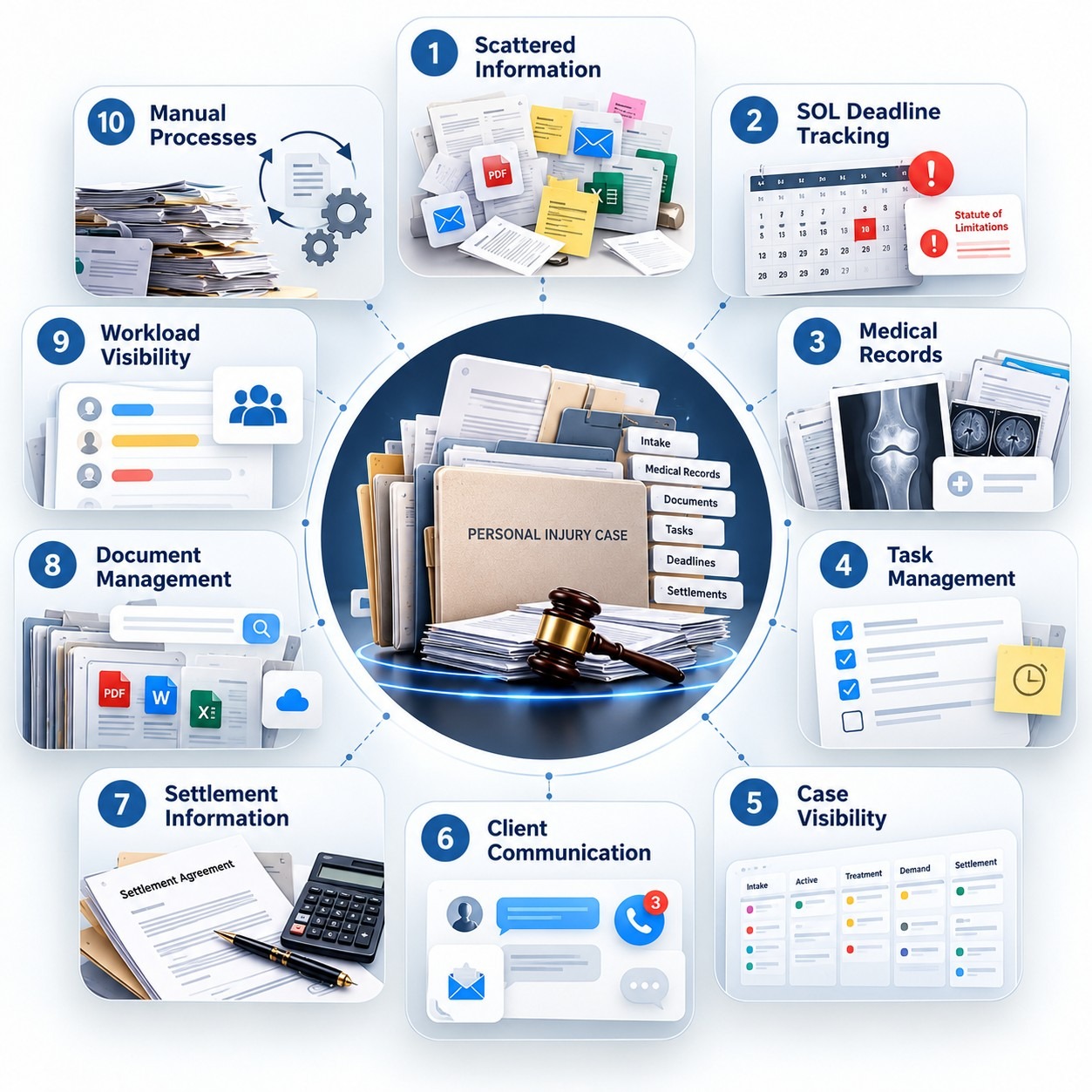
1. Information Is Scattered Across Multiple Systems
One of the most common problems is information fragmentation.
Client information may be stored in a case file, medical records in a document folder, deadlines in a calendar, communications in email, and financial information in spreadsheets or accounting software.
The information exists, but employees have to search across multiple locations to understand the complete case.
A centralized case record can reduce this fragmentation by connecting important information to the underlying matter.
2. Statute of Limitations Deadlines Are Difficult to Track
Personal injury firms manage deadlines that can vary according to jurisdiction, claim type, and case circumstances.
Relying on individual calendars, spreadsheets, or memory can make it difficult for managers to see which matters require attention.
A structured process should identify the applicable deadline, assign responsibility, establish advance reminders, and provide visibility into approaching dates.
Technology can support this workflow, but legal professionals still need to verify the applicable rule and deadline.
3. Medical Records Are Difficult to Organize
Medical records can quickly become one of the largest collections of documents in a personal injury case.
A client may receive treatment from several providers, each producing different records, reports, bills, and imaging.
Without a consistent structure, attorneys may spend significant time searching through documents simply to understand the treatment history.
A medical chronology can help organize treatment by date, provider, diagnosis, procedure, and relevant findings while keeping the original records available for detailed review.
4. Tasks and Follow-Ups Fall Through the Cracks
Personal injury cases involve numerous recurring tasks.
A paralegal may need to request records, follow up with a provider, contact an insurance carrier, obtain a document, update a client, or prepare material for an attorney.
When these tasks are managed informally through emails, notes, or individual reminders, ownership can become unclear.
A task-management workflow should make it clear:
What needs to be done → Who owns it → When it is due → What is its current status
This simple visibility can significantly improve operational consistency.
5. Case Status Is Difficult to Understand
A law firm may have hundreds of active matters at different stages.
Without standardized case stages, management may struggle to answer basic questions:
Which cases are still in intake?
Which clients are receiving treatment?
Which cases are ready for demand?
Which demands are under negotiation?
Which settlements need to be processed?
Which cases have stalled?
Standardized case stages can provide a consistent way to understand where every matter sits in the overall workflow.
6. Client Communication Becomes Disconnected
Clients may communicate through phone calls, emails, messages, and meetings.
If these interactions are not recorded consistently, another attorney or staff member may have difficulty understanding what was previously discussed.
A centralized communication history allows authorized team members to see relevant interactions without depending on one employee's personal inbox or notes.
Client portals can also provide a structured channel for document exchange, updates, and other client-facing activities.
7. Settlement Information Is Spread Across Spreadsheets
Settlement is often one of the most financially detailed stages of a personal injury case.
The firm may need to account for settlement amounts, attorney fees, expenses, medical bills, liens, deductions, and client distributions.
When these calculations are maintained across separate spreadsheets and documents, it becomes harder to maintain a consistent record.
A connected settlement workflow can bring the relevant financial information together with the case and its supporting documentation.
8. Document Management Becomes Overwhelming
A personal injury matter can accumulate a large number of documents over its lifecycle.
Without consistent naming, categorization, permissions, and search capabilities, finding the correct document can become a daily administrative burden.
A good document-management process should allow team members to quickly identify what a document is, which case it belongs to, and whether it is the latest relevant version.
9. Firms Have Limited Visibility Into Workload
Case-management problems are not always visible at the individual case level.
Management also needs to understand the workload across the firm.
For example, one paralegal may be responsible for significantly more active matters than another, while one attorney may have a large number of cases approaching critical deadlines.
Reporting and dashboards can help leadership identify workload concentrations, overdue tasks, approaching deadlines, and case-stage distribution.
This allows operational problems to be addressed before they become bottlenecks.
10. Too Much Work Depends on Manual Processes
Manual work is not necessarily bad, but repetitive manual processes can consume substantial staff time.
Examples include manually creating recurring tasks, sending routine reminders, updating case stages, checking approaching deadlines, requesting information, and maintaining separate tracking spreadsheets.
Workflow automation can reduce repetitive administrative work and create greater consistency.
The objective is not to automate every decision. Legal judgment should remain with the appropriate professionals. Instead, automation should handle predictable administrative actions around the legal workflow.
How These Problems Are Connected
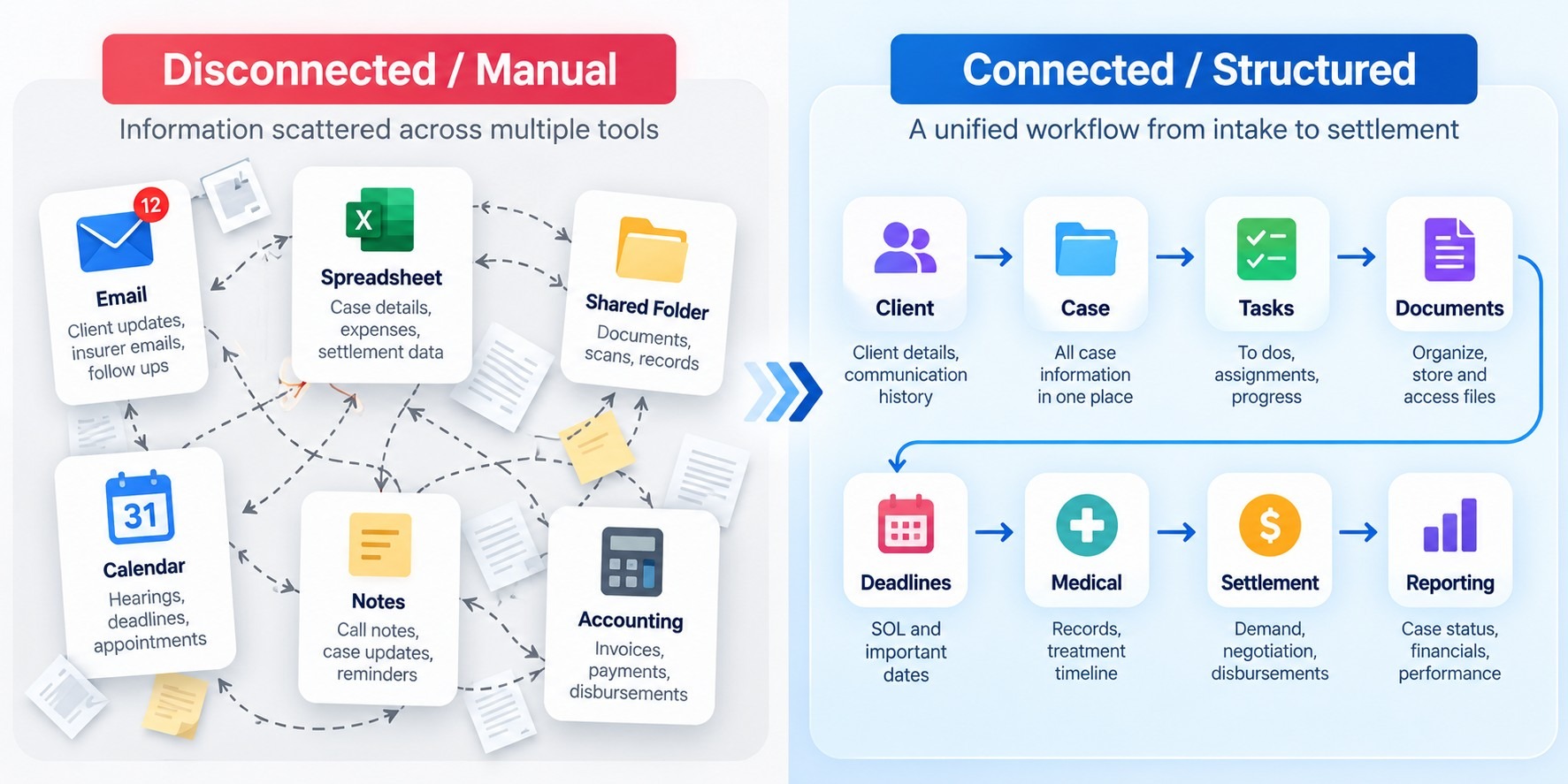
These problems rarely exist independently.
For example, scattered information can make it harder to track deadlines. Poor task management can delay medical-record requests. Missing records can delay demand preparation. Delayed demands can affect settlement timelines.
The underlying problem is often a disconnected case workflow.
A more connected process looks like:
Intake → Investigation → Treatment → Medical Records → Damages → Demand → Negotiation → Settlement → Closing
Each stage has its own documents, tasks, deadlines, communications, and responsibilities.
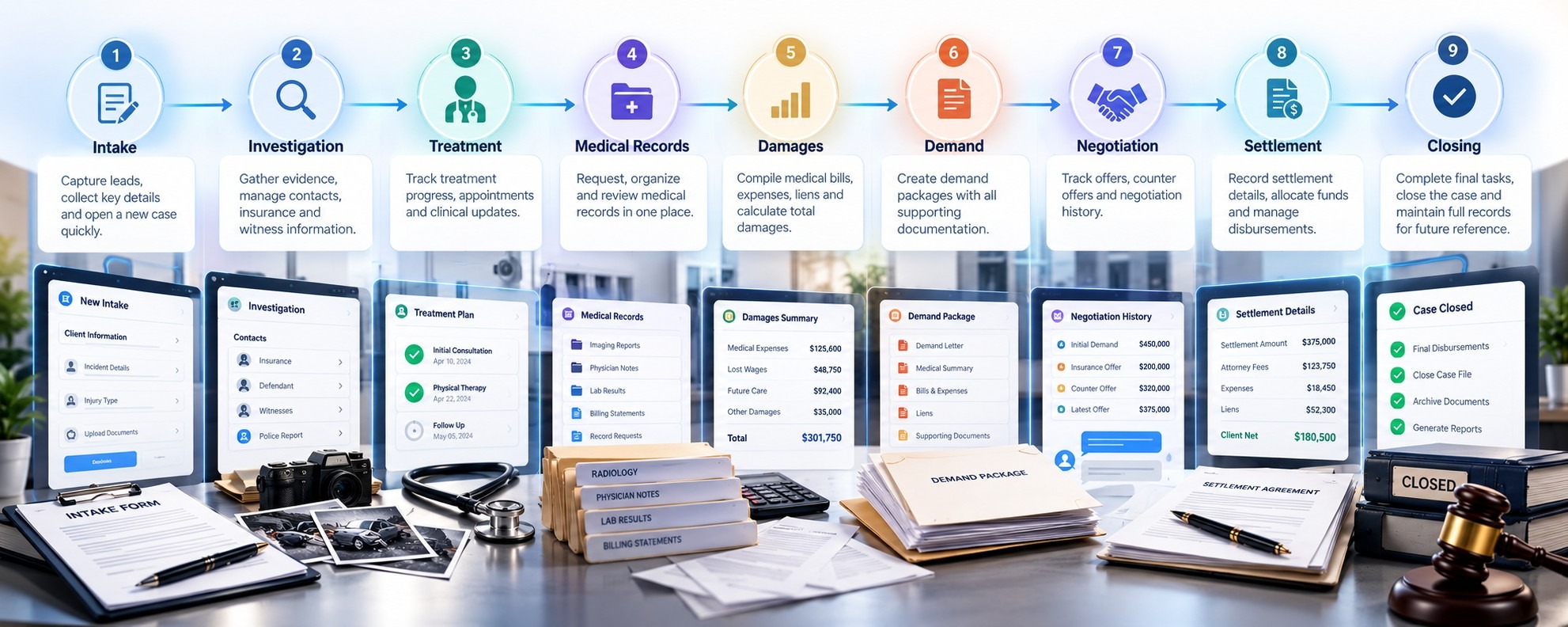
When these elements are connected to the same case record, the firm has greater visibility into what has happened and what needs to happen next.
How Law Firms Can Start Improving Case Management
Firms do not necessarily need to change everything at once.
A practical starting point is to identify the areas creating the most operational friction.
Ask:
Where are employees spending the most time searching for information?
Which deadlines require the most manual monitoring?
Which tasks are frequently delayed?
Which documents are hardest to locate?
Where does information get entered more than once?
Which case stages are difficult for management to monitor?
Which processes depend heavily on individual employees?
The answers can reveal where standardization and automation will provide the greatest benefit.
Final Thoughts
Personal injury law firms handle complex workflows with many moving parts. When information, tasks, deadlines, documents, communications, and financial details are managed separately, administrative problems can accumulate quickly.
The solution is not simply to add more tools. It is to create a more connected case-management process.
By centralizing important information, standardizing case stages, assigning responsibility, monitoring deadlines, organizing medical records, improving communication, and automating repetitive workflows, firms can create a more consistent operating environment for their legal teams.
For a growing plaintiff firm, better case management is ultimately about creating visibility and control across the entire lifecycle of every case.