

A personal injury case can involve hundreds or even thousands of pages of medical records from hospitals, emergency departments, specialists, imaging centers, physical therapists, and other healthcare providers.
Finding the important details across these documents can be time-consuming. Attorneys need to understand when treatment began, how an injury progressed, what diagnoses were documented, which procedures were performed, and whether there are gaps or inconsistencies in the available records.
This is where a medical chronology becomes valuable.
A medical chronology organizes relevant medical events into a structured, date-ordered timeline. It helps plaintiff attorneys understand the client's treatment history without repeatedly searching through large volumes of raw medical documentation.
1. What Is a Medical Chronology?
A medical chronology is a factual, chronological summary of a patient's medical treatment and relevant healthcare history.
It organizes information from medical records according to the date of each encounter, making it easier to follow the progression of an injury and the treatment received.
A typical medical chronology includes:
Date of medical visit or procedure.
Healthcare provider and facility.
Patient's reported symptoms and complaints.
Clinical examination findings.
Diagnoses documented by the provider.
Imaging and diagnostic test results.
Treatments, medications, and procedures.
Physician recommendations and referrals.
Work restrictions or functional limitations, where documented.
References to the original medical records and page numbers.
A well-prepared chronology should allow an attorney to locate the supporting source document for every important entry. It should distinguish documented medical facts from observations or questions requiring further review.
2. Why Does a Medical Chronology Matter in Personal Injury Cases?
Medical records are central to understanding the injuries and damages claimed in a personal injury matter. However, reviewing those records without a structured timeline can make it difficult to identify the complete treatment history.
A medical chronology helps law firms in several ways.
Understanding the Progression of Injuries
The chronology provides a clear sequence of events, from the first medical evaluation through subsequent treatment, rehabilitation, and follow-up appointments.
Attorneys can review how symptoms developed, which diagnoses were recorded, and what treatment providers recommended over time.
Identifying Gaps in Medical Treatment
Periods without documented treatment may become relevant during settlement negotiations or litigation.
A chronology helps identify intervals between appointments, missed follow-ups, and referrals for which corresponding records may not be available.
A treatment gap does not automatically mean that an injury was resolved or that the client is not credible. Its significance must be assessed in context and, where appropriate, investigated.
Reviewing Pre-Existing Conditions
Some clients have medical conditions or previous injuries that existed before the accident.
A chronology can help distinguish documented pre-incident medical history from treatment occurring after the incident. This can be important when evaluating whether an accident caused a new injury or aggravated an existing condition.
Understanding Medical Expenses and Treatment
By organizing encounters, procedures, and provider information, a chronology helps attorneys review the course of treatment alongside medical bills and other damages documentation.
It can also highlight missing billing records or providers whose treatment is mentioned in the file but whose complete documentation has not yet been obtained.
Preparing for Settlement Negotiations and Litigation
A structured medical timeline makes it easier for attorneys to locate important medical events when preparing demand packages, reviewing insurer questions, preparing for depositions, and working with medical experts.
It provides a more organized way to navigate the evidence while keeping the original medical records available for verification.
3. What Does a Medical Chronology Look Like?
A medical chronology is commonly presented as a table or structured report.
For example, consider a fictional client involved in a rear-end vehicle collision:
Each entry should also identify the provider, facility, and source document or page reference.
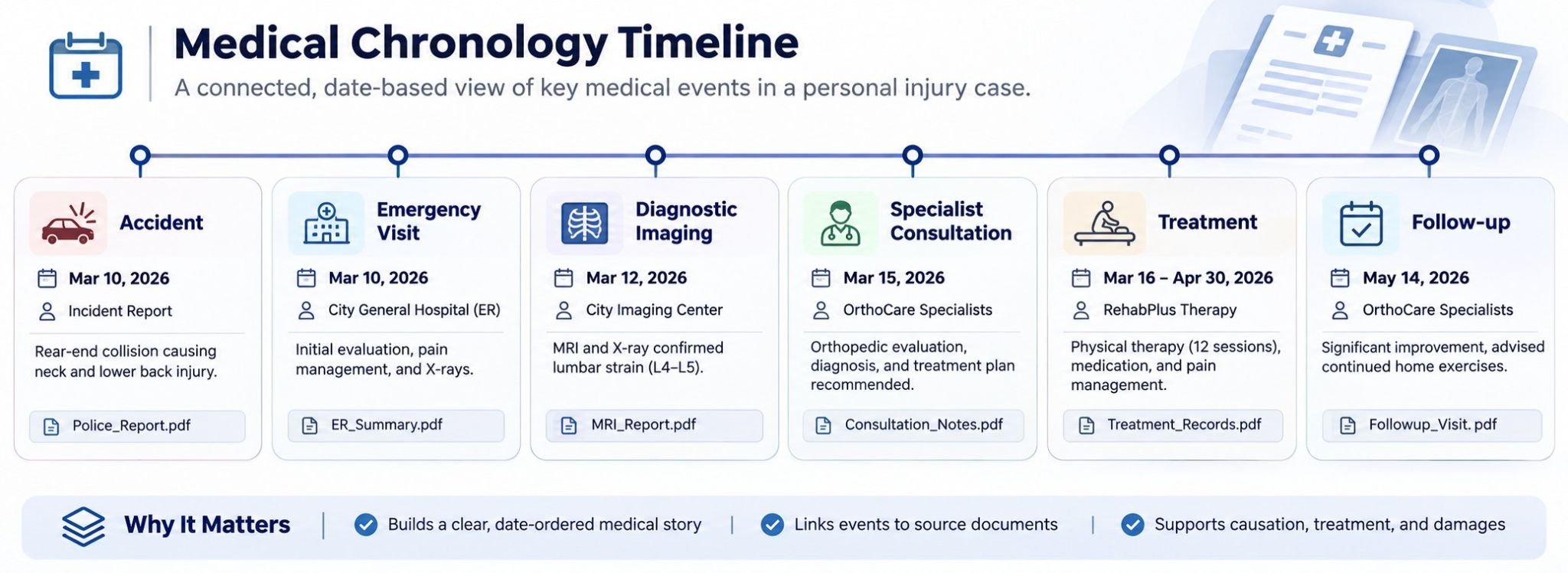
This example illustrates how multiple medical encounters can be organized into one readable timeline. The actual clinical significance of any diagnosis or imaging result must be determined from the underlying records and appropriate medical expertise.
4. Medical Chronology vs. Medical Summary: What Is the Difference?
These terms are often used interchangeably, but they serve different purposes.
Medical Chronology: A date-ordered account of medical events. It answers what happened, when it happened, who documented it, and where the information can be verified.
Medical Summary: A condensed narrative of the patient's medical history, major diagnoses, treatment progression, and relevant findings. It focuses on explaining the broader medical picture.
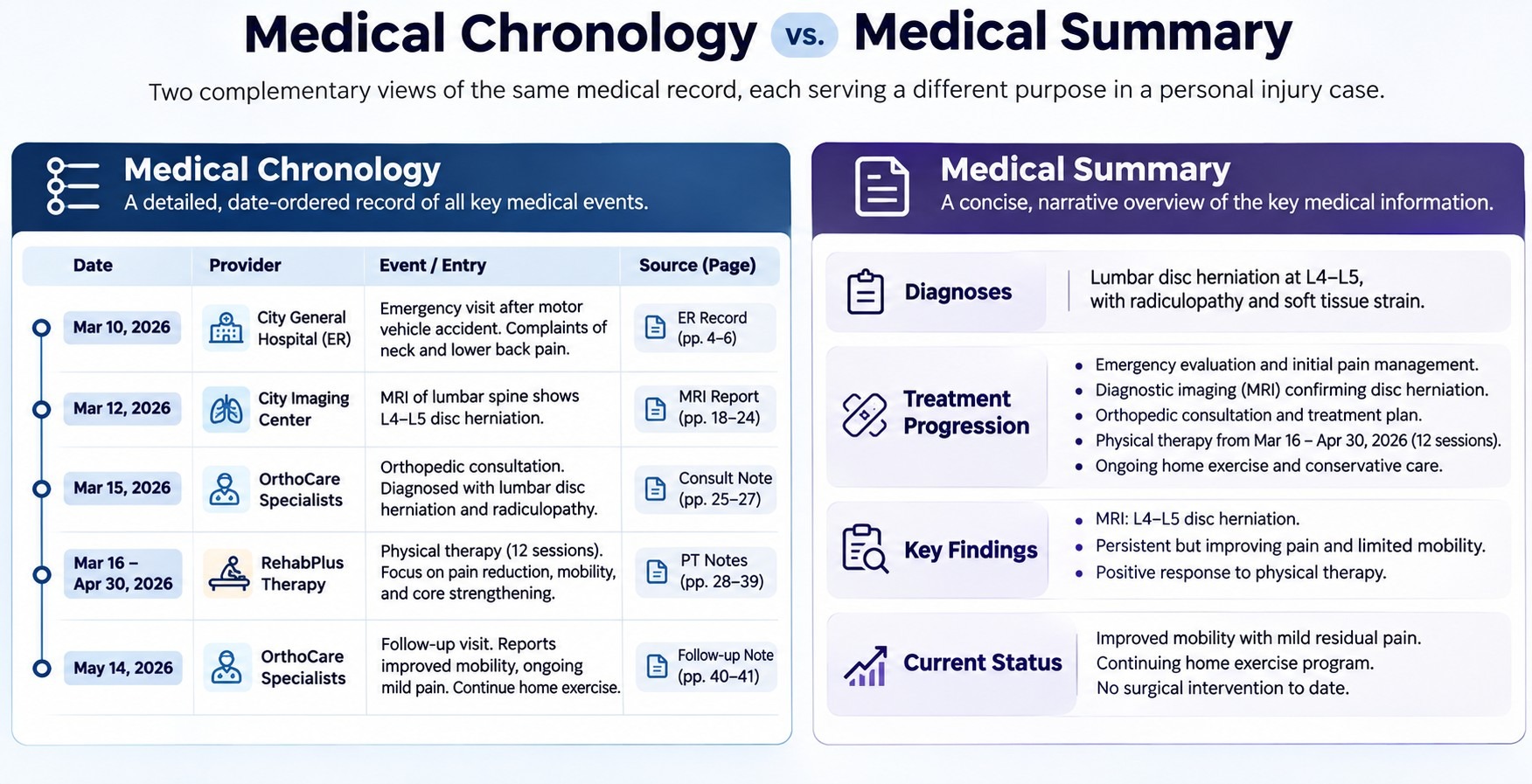
A chronology provides the detailed timeline, while a summary gives the reader a shorter overview. Depending on the complexity of the case, a law firm may need both.
Neither document should replace the original records or an independent medical expert's assessment when clinical interpretation is required.
5. Common Problems When Reviewing Large Medical Record Files
Preparing a reliable chronology manually can be challenging, particularly when records come from multiple providers and contain duplicate pages, inconsistent formatting, or incomplete information.
Common problems include:
Large document volumes: Important information may be buried in hundreds of pages.
Duplicate records: The same encounter may appear in multiple documents.
Missing information: Referrals, follow-up visits, or referenced providers may have no corresponding records in the file.
Inconsistent dates: Document dates, service dates, and report dates may differ.
Medical terminology: Clinical abbreviations and technical language require careful handling.
Pre-existing conditions: Relevant medical history may be mixed with post-incident treatment.
Incorrect extraction: Negated findings, suspected diagnoses, and confirmed diagnoses can be confused.
These issues make verification essential. A chronology should never be treated as reliable simply because it looks organized.
6. How Law Firms Can Prepare a Reliable Medical Chronology
A consistent process can improve the quality and usability of medical chronologies.
Collect the records: Obtain relevant documentation from hospitals, physicians, imaging centers, rehabilitation facilities, and other providers.
Organize the documents: Sort records by provider and date, identify duplicates, and maintain the original files.
Extract relevant events: Identify medical encounters, complaints, findings, diagnoses, tests, treatments, and recommendations.
Build the timeline: Arrange the events in chronological order using the actual dates of service.
Add source references: Link each entry to its supporting document and page number.
Flag issues for review: Identify possible treatment gaps, missing records, inconsistent histories, and pre-existing conditions without presenting assumptions as established facts.
Verify the chronology: Compare extracted information against the original records and correct errors.
Update it regularly: Add new medical records as treatment continues and preserve the accuracy of previously reviewed entries.
7. Can AI Help Create Medical Chronologies?
AI-assisted document processing can help law firms handle large volumes of medical records more efficiently.
Depending on the system and its capabilities, AI can assist with extracting dates, identifying providers, organizing diagnoses and treatment events, and creating an initial chronological draft from uploaded documents.
However, AI-generated chronologies require human review.
Attorneys and qualified reviewers should verify important details against the original records, particularly diagnoses, medication information, imaging findings, treatment dates, and statements about causation or prognosis.
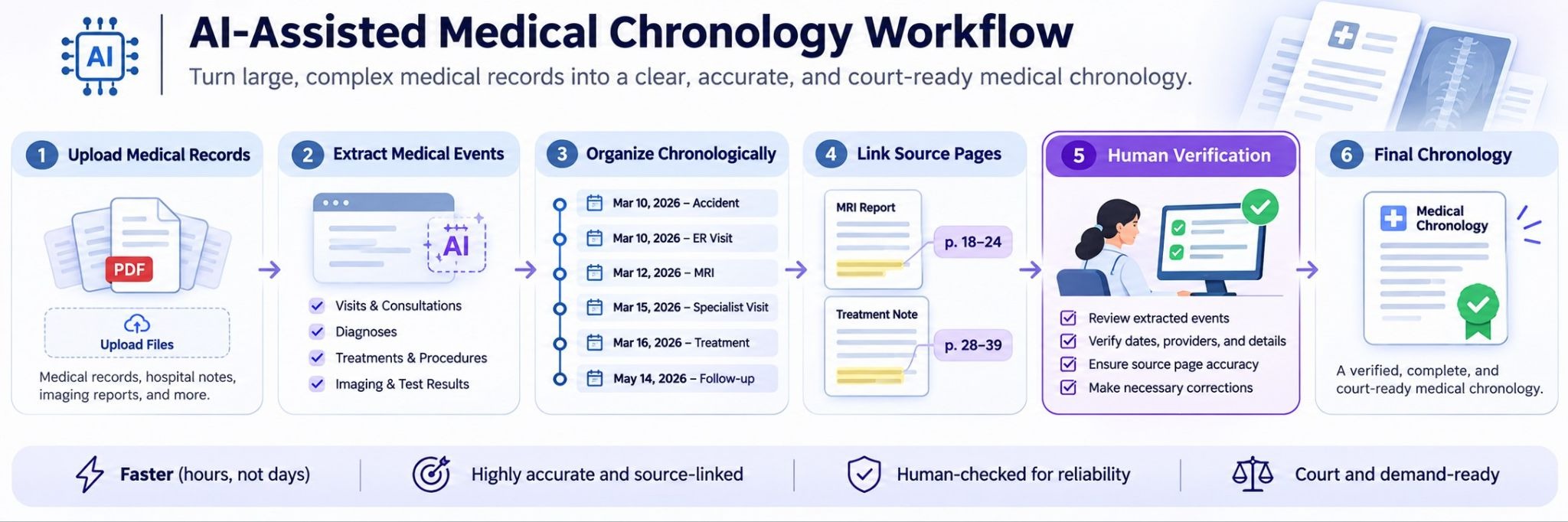 A reliable workflow should also preserve source references so that reviewers can trace each extracted detail back to the relevant medical document.
AI should support document organization and review, not replace legal judgment or qualified medical interpretation.
Final Thoughts
A medical chronology is an important case-preparation resource for personal injury law firms. It transforms scattered medical documentation into an organized timeline that helps attorneys understand treatment history, identify missing information, review damages, and prepare for negotiations or litigation.
As medical record volumes grow, firms need more efficient ways to organize, review, and maintain these timelines without compromising accuracy.
The objective is not simply to create a shorter version of medical records. It is to make the underlying evidence easier to navigate, verify, and use throughout the case.
Looking for Personal Injury Case Management Software?
Managing medical records across multiple personal injury cases can become a significant administrative burden. Lextiff is a legal case management platform built for plaintiff law firms, with medical record management and medical chronology workflows designed to help teams organize case-related medical information.
Explore Lextiff to learn more about medical record organization, medical chronology management, and a more structured approach to personal injury case management.


