

Managing personal injury cases involves more than collecting medical records, negotiating with insurance companies, and preparing settlement demands. Every matter has deadlines that can affect the client's legal rights, the firm's litigation strategy, and the overall progress of the case.
Missing a critical filing deadline can put an otherwise valid claim at risk. Other missed dates, such as discovery cutoffs or court-ordered submissions, can lead to procedural complications, sanctions, or limitations on the evidence a party may present.
For plaintiff law firms handling multiple active cases, a structured deadline-tracking process is essential.
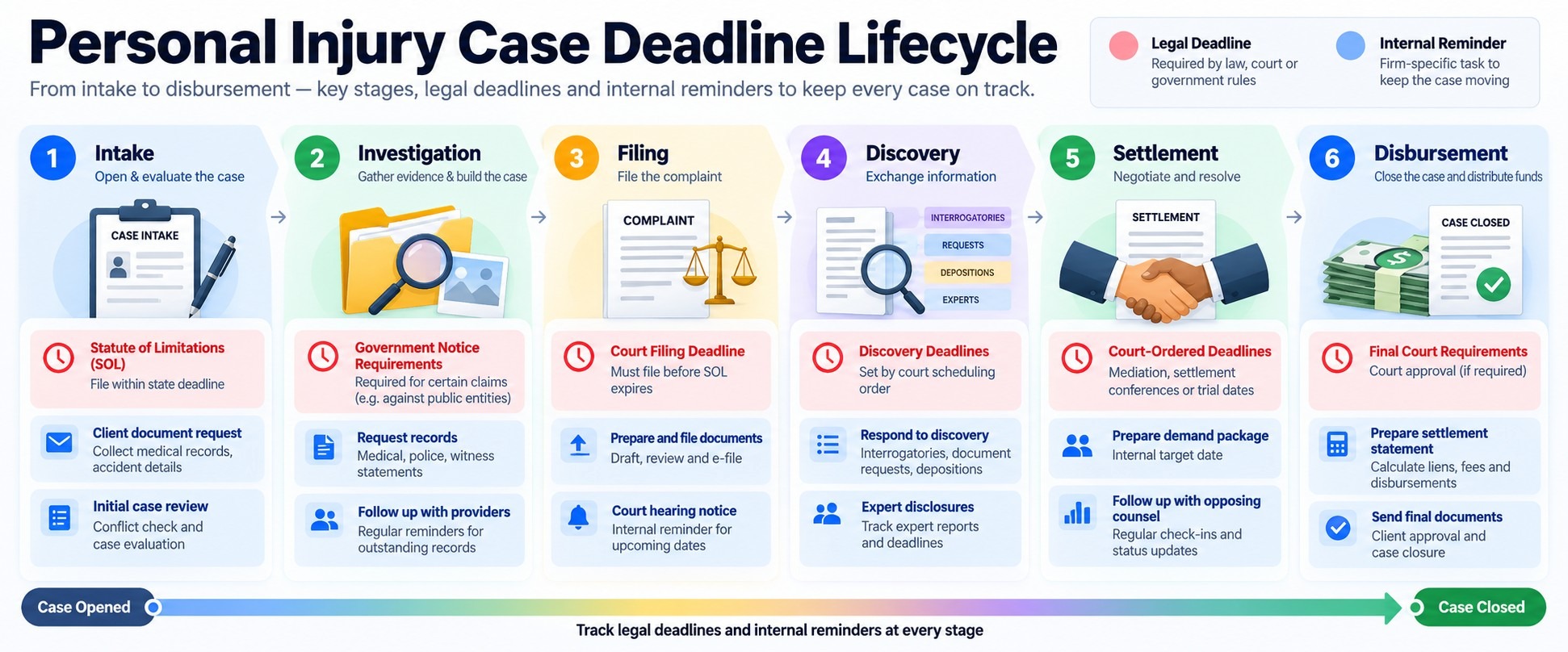
This personal injury case deadline checklist provides a practical framework for tracking important dates from initial client intake through settlement or trial.
1. Initial Case Intake and Investigation Deadlines
Deadline management should begin as soon as a potential client contacts the firm. The first priority is identifying when the incident occurred, where it happened, and which legal deadlines may apply.
Initial case intake checklist:
Record the date and approximate time of the accident.
Identify the location and applicable jurisdiction.
Record the date the client first discovered the injury, if different from the accident date.
Identify all potentially responsible individuals, businesses, or entities.
Determine whether a government agency or employee may be involved.
Identify potential witnesses and available contact information.
Request accident reports, photographs, and other initial evidence.
Identify any immediate evidence-preservation concerns.
Flag the matter for an attorney's deadline review.
The firm should not rely solely on the date entered in an intake form. The applicable legal trigger may depend on the type of claim, the defendant, and specific circumstances.
2. Statute of Limitations and Notice Deadlines
The statute of limitations is one of the most important deadlines in a personal injury case. It generally establishes the period within which a lawsuit must be commenced.
However, there is no single nationwide personal injury filing deadline. The applicable period varies by state, claim type, and circumstances.
For example, California generally provides two years for personal injury actions, while New York generally provides three years for many negligence-based personal injury claims. Claims involving government entities may have separate and significantly shorter notice requirements.
Statute of limitations checklist:
Identify the applicable state and jurisdiction.
Confirm the legal basis of each potential claim.
Determine the applicable limitations period.
Verify the event that starts the limitations clock.
Check whether a discovery rule, tolling provision, minority rule, or other exception may apply.
Determine whether multiple defendants have different deadline considerations.
Identify any government notice-of-claim requirements.
Verify whether a separate administrative claim or pre-suit procedure is required.
Record the verified deadline and supporting legal authority.
Set internal review dates well before the legal deadline.
Escalate uncertain or high-risk calculations to the responsible attorney.
Important: Sending an insurance demand, negotiating a settlement, or continuing medical treatment does not automatically extend or suspend the statute of limitations. The responsible attorney must verify the applicable law and ensure that required action is taken before the deadline.
3. Medical Records and Evidence Collection Deadlines
Evidence collection is an ongoing process. Delayed records, incomplete documentation, and unresolved preservation issues can affect both case preparation and settlement negotiations.
Evidence management checklist:
Request initial medical records and billing statements.
Track outstanding medical record requests.
Follow up with healthcare providers when records are delayed.
Obtain accident and police reports where applicable.
Preserve photographs, videos, and relevant digital evidence.
Identify surveillance footage that may be subject to retention limits.
Record witness contact details and follow-up requirements.
Track expert evaluations and supporting reports.
Maintain a record of evidence received and still outstanding.
Review whether additional evidence preservation steps are necessary.
Internal follow-up dates should be assigned to outstanding requests. These are operational reminders, not necessarily statutory or court-imposed deadlines.
4. Litigation and Court Filing Deadlines
When settlement negotiations do not resolve the dispute, the case may proceed to litigation. At this stage, the firm must track court deadlines alongside the original statute of limitations analysis.
Litigation checklist:
Confirm the complaint filing deadline.
Prepare and file the complaint within the applicable period.
Track service-of-process requirements and deadlines.
Record the defendant's response deadline.
Track motions and opposition or reply deadlines.
Record scheduling conference dates.
Monitor court orders and amended scheduling orders.
Track pretrial conference and trial dates.
Verify filing and service requirements under the applicable court rules.
Court deadlines can vary between state and federal courts, and even between individual cases. The court's scheduling order and applicable procedural rules should be treated as the controlling references.
5. Discovery and Expert Disclosure Deadlines
Discovery involves exchanging information and evidence relevant to the claims and defenses. It may include interrogatories, requests for production, requests for admission, depositions, and expert disclosures.
Missing a discovery deadline can affect the firm's ability to obtain evidence or present its case.
Discovery checklist:
Record the discovery commencement date, where applicable.
Track deadlines for responding to written discovery.
Monitor document production and outstanding requests.
Schedule and track depositions.
Record expert disclosure deadlines.
Track expert report preparation and exchange.
Monitor independent medical examination scheduling, where applicable.
Track discovery motion deadlines.
Record the discovery cutoff date.
Review outstanding discovery before the cutoff.
For example, Federal Rule of Civil Procedure 26 addresses initial disclosures, discovery planning, and expert disclosures. State court procedures may differ. Firms should verify the applicable rules and scheduling orders rather than applying one standard timeline to every case.
6. Settlement, Liens, and Disbursement Deadlines
Settlement does not necessarily end the firm's deadline-management responsibilities. Once the parties reach an agreement, documentation, approvals, lien resolution, and payment processing may remain outstanding.
Settlement checklist:
Record the settlement offer and response dates.
Track demand package submission and insurer follow-ups.
Record mediation dates and related requirements.
Monitor settlement approval requirements, including court approval where applicable.
Track settlement agreement preparation and signature status.
Record any payment deadline stated in the settlement agreement.
Identify medical liens and reimbursement claims.
Track lien verification and resolution.
Reconcile case expenses and authorized deductions.
Prepare the final settlement statement.
Track client disbursement and file closure.
The timing and requirements for settlement approval, lien resolution, and payment depend on the case, applicable law, and settlement terms.
7. Internal Case Review and Client Communication Reminders
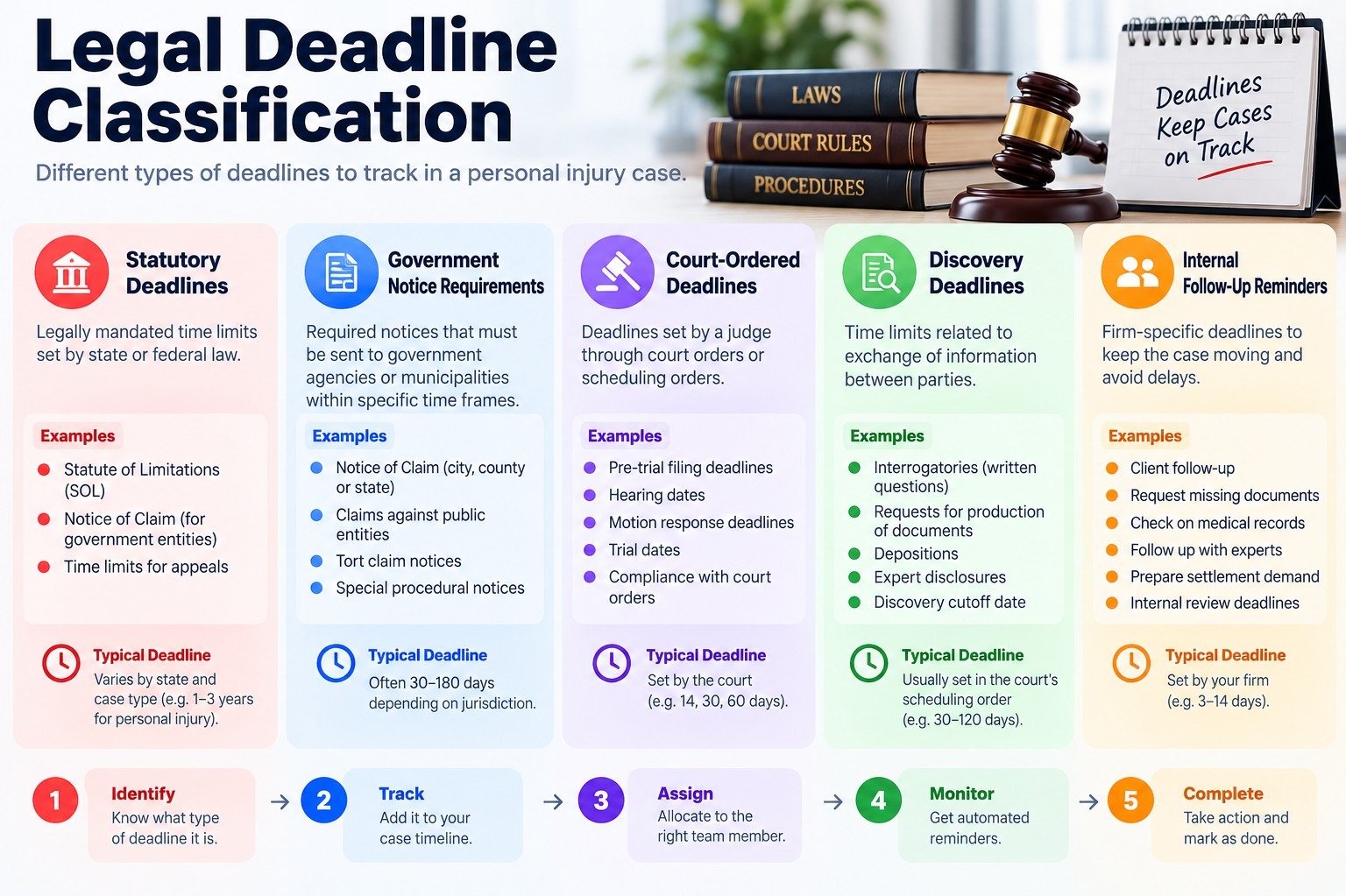
Not every important date is imposed by a statute or court. Internal reminders help the firm maintain communication, prevent administrative delays, and identify inactive cases.
Internal workflow checklist:
Schedule periodic case-status reviews.
Follow up with clients regarding treatment progress.
Review outstanding medical records and bills.
Track insurance adjuster communications.
Schedule follow-ups for unanswered correspondence.
Review cases with no recent activity.
Monitor upcoming deadlines across the firm's caseload.
Assign each follow-up to a responsible team member.
Escalate overdue tasks and critical deadline risks.
Document important client communications.
These reminders should be clearly distinguished from legally binding deadlines so that staff members understand which dates require attorney review and which are routine operational follow-ups.
8. How Law Firms Can Build a Reliable Deadline Tracking System
A checklist is useful, but relying on spreadsheets, handwritten notes, individual calendars, or memory alone can become difficult as the number of active cases grows.
A reliable deadline-management process should include:
Centralized case records: Keep accident dates, filing deadlines, court dates, and case-related documents organized within the relevant matter.
Verified deadline entries: Record the source and legal basis for each critical deadline. Calculations should be reviewed by the responsible attorney.
Advance reminders: Create internal reminders before critical dates, allowing enough time for review and action.
Clear task ownership: Assign follow-ups and case-related tasks to specific team members rather than leaving responsibility unclear.
Regular case reviews: Review upcoming deadlines, overdue tasks, outstanding documents, and inactive matters at regular intervals.
Escalation procedures: Establish a clear process for notifying the responsible attorney when a critical deadline is approaching or an assigned task remains incomplete.
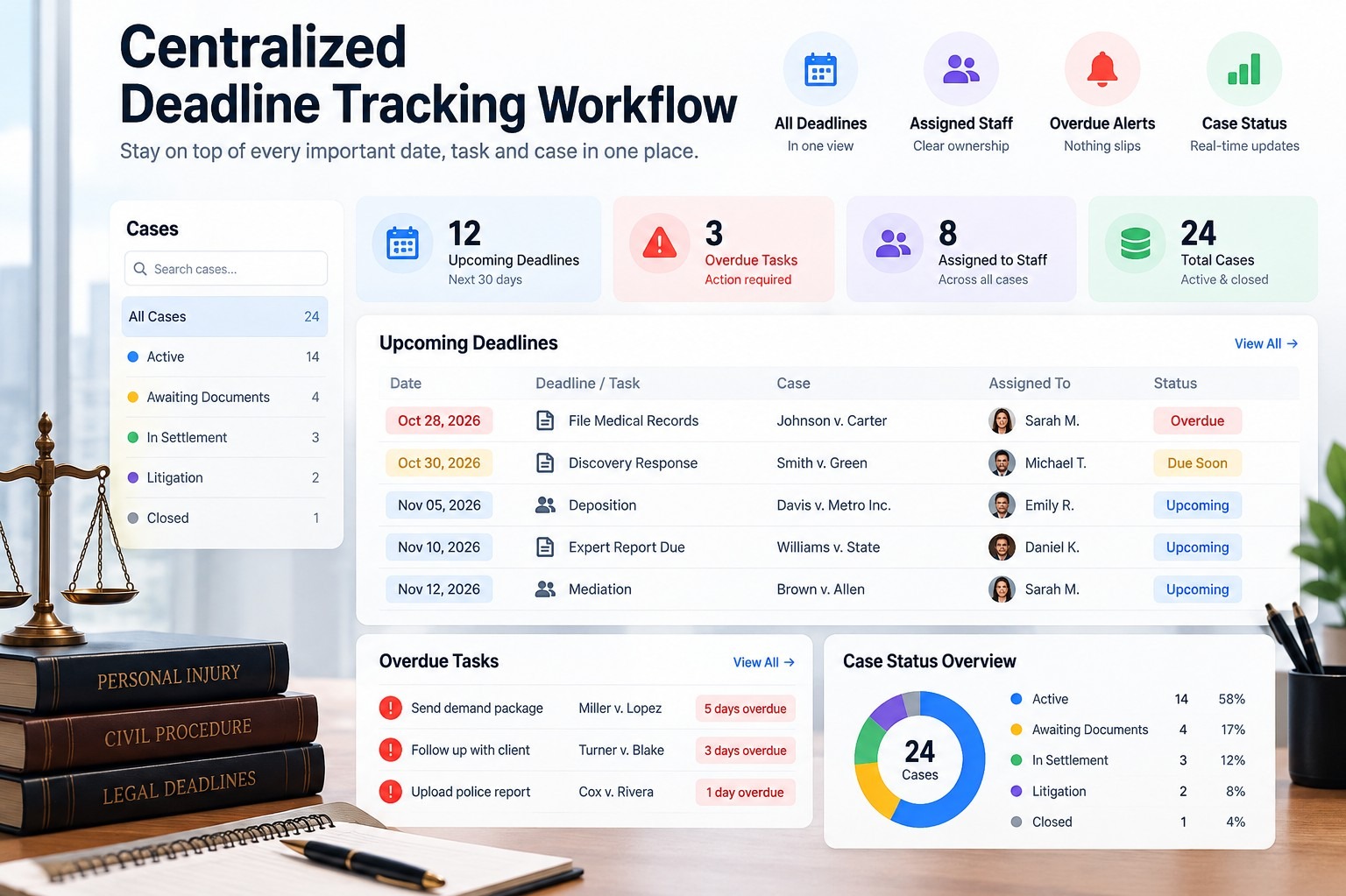
A dependable system should make it easy to identify what is due, when it is due, who is responsible, and whether the task has been completed.
Final Thoughts
Personal injury deadline management requires consistent attention from the first client inquiry through final case resolution. Statutes of limitations, government notice requirements, court filings, discovery obligations, expert disclosures, and settlement-related dates all need appropriate oversight.
For plaintiff law firms managing multiple matters, the objective should be to create a repeatable process that reduces administrative gaps and gives attorneys clear visibility into upcoming obligations.
A well-maintained checklist, supported by organized case records and a reliable tracking system, can help firms manage their caseloads with greater consistency.
Looking for Personal Injury Case Management Software?
Managing deadlines across dozens or hundreds of personal injury matters can become difficult without a structured workflow. Lextiff is a legal case management platform designed for personal injury law firms, helping teams organize case information, tasks, events, documents, and important case activities.
Explore Lextiff to learn how a centralized legal case management platform can support a more organized approach to personal injury case management and deadline tracking.


