


Preparing a medical chronology is an important part of personal injury case preparation, but it can also consume a significant amount of time.
A single case may contain hundreds of pages of emergency department notes, physician consultations, diagnostic reports, prescription records, physical therapy notes, and billing documents. Attorneys and paralegals must review this information, identify relevant medical events, arrange them chronologically, and verify that the resulting timeline accurately reflects the original records.
When a law firm handles multiple active personal injury cases, preparing these chronologies manually can become a substantial administrative workload.
The solution is not simply to review records faster. It is to build a structured process that reduces repetitive work while maintaining accuracy.
1. Start by Organizing Medical Records Before Reviewing Them
One of the biggest sources of wasted time is reviewing disorganized medical documents.
Before extracting information, group records into logical categories:
Emergency department and hospital records.
Primary care and physician consultations.
Specialist evaluations.
Diagnostic imaging and laboratory reports.
Physical therapy and rehabilitation records.
Surgical and procedure reports.
Prescription and medication records.
Medical bills and statements.
Organize documents by provider and date wherever possible. Identify duplicate files and separate incomplete or unreadable documents for follow-up.
 This initial preparation makes it easier to review the treatment history without repeatedly searching through unrelated documents.
2. Use a Standardized Medical Chronology Template
Starting every chronology from a blank document creates unnecessary work. A standardized template allows paralegals and case managers to follow the same structure across matters.
A useful medical chronology template should include:
Not every field will apply to every encounter. The objective is to capture relevant information consistently, not to fill every column unnecessarily.
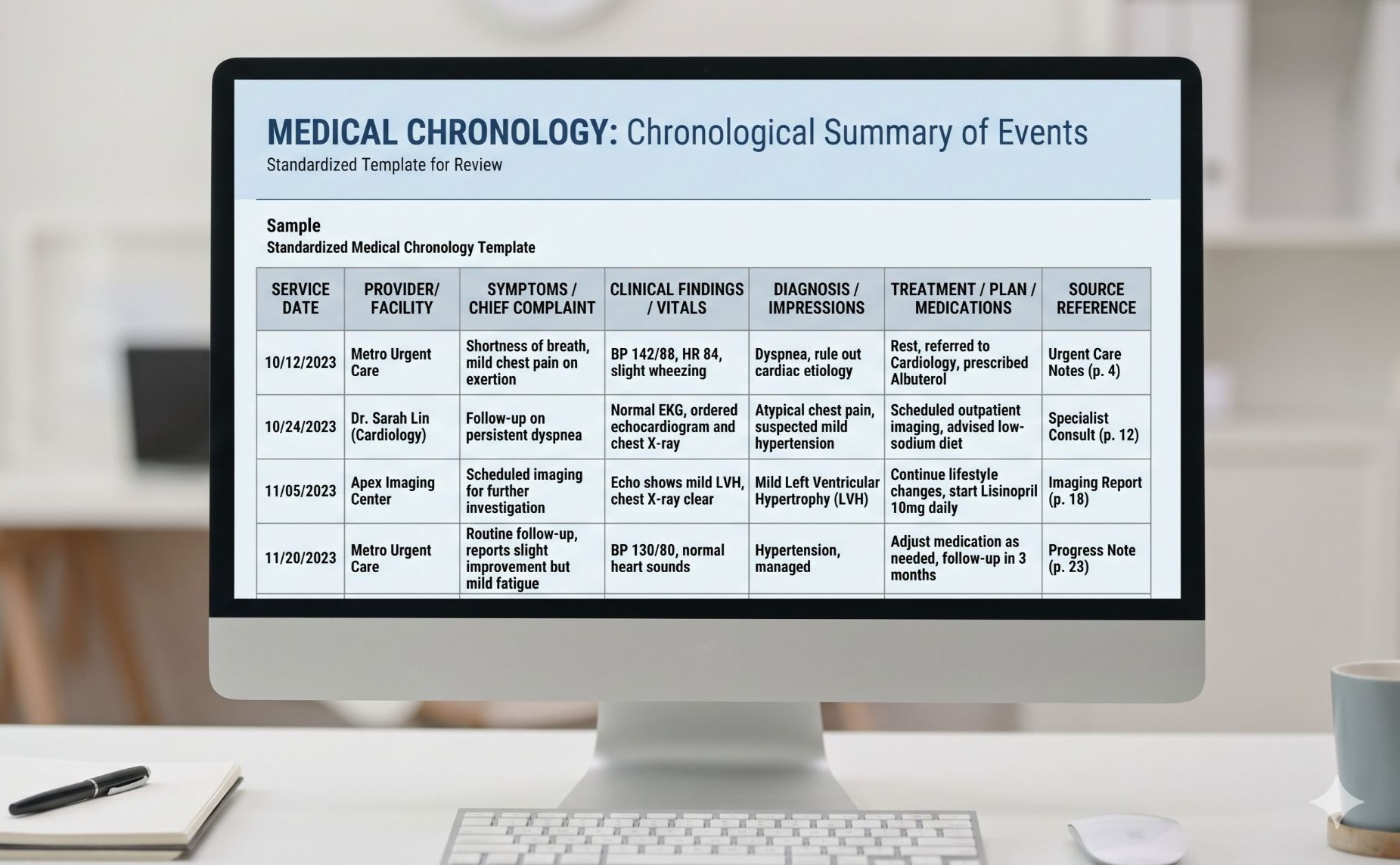
A standard format also makes chronologies easier for attorneys to review and compare.
3. Extract Relevant Medical Events Instead of Copying Everything
A medical chronology should not become a duplicate of the patient's medical records.
The reviewer should identify information relevant to the injury and the legal issues being evaluated.
For each encounter, focus on:
Reported symptoms and changes in complaints.
Diagnoses and documented clinical findings.
Imaging results and other diagnostic tests.
Treatment provided and medications prescribed.
Referrals and specialist recommendations.
Changes in physical function or work restrictions, where documented.
Follow-up instructions and subsequent treatment.
Avoid copying entire paragraphs when a concise factual summary will communicate the relevant information.
However, do not remove details simply because they appear inconsistent or unfavorable. Accurate chronologies should reflect the records objectively, including information that may require further investigation.
4. Use a Consistent Review and Verification Process
Speed is useful only when the resulting chronology is reliable.
Medical documents may contain different dates for the encounter, report preparation, and document upload. They may also include duplicate entries, conflicting histories, abbreviations, or incomplete information.
A practical review process should include:
Confirm the actual date of service.
Identify the provider and facility.
Extract relevant medical information.
Summarize the event without changing its meaning.
Record the original document and page reference.
Compare the entry against the source record.
Flag unclear or conflicting information for further review.
Pay particular attention to diagnoses, imaging findings, medication details, and statements about injury progression.
A chronology is an organizational and factual record. It should not independently declare medical causation, interpret complex clinical findings, or substitute for expert medical opinion.
5. Use Technology to Reduce Repetitive Administrative Work
Technology can make medical chronology preparation more manageable, especially when firms handle large document volumes.
Useful capabilities include:
Document organization: Store medical records within the relevant case instead of distributing files across unrelated folders.
Searchable records: Make it easier to locate specific providers, dates, diagnoses, or document references.
Structured chronology workflows: Use consistent fields and layouts to reduce repetitive formatting.
Task and follow-up management: Track missing records, pending requests, and outstanding verification work.
Centralized case information: Keep medical documentation and relevant case activities accessible to authorized team members.
Technology should support the review process rather than create another disconnected system for staff to maintain.
6. Can AI Make Medical Chronology Preparation Faster?
AI-assisted document processing can help reduce the manual effort involved in reviewing large volumes of medical records.
Depending on the technology, AI tools may assist with:
Extracting dates and provider information.
Identifying diagnoses and documented symptoms.
Locating treatment events across multiple records.
Organizing extracted information into chronological order.
Producing an initial structured chronology for review.
However, AI-generated content should never be treated as automatically accurate.
A reviewer must verify the extracted information against the original records, check for missing or duplicated events, and ensure that medical terminology and clinical context have not been distorted.
Law firms should also evaluate data privacy, confidentiality, access controls, retention policies, and vendor security before uploading sensitive medical records to any third-party AI service.
The most effective approach is to use automation for repetitive document-processing tasks while keeping human verification central to the workflow.
7. Create a Repeatable Medical Chronology Workflow
For consistent results across multiple cases, establish a standard operating procedure:
Collect and organize medical records.
Identify missing documents and request outstanding records.
Remove or flag duplicate and unreadable files.
Sort records by date of service.
Extract relevant medical events.
Populate the standardized chronology template.
Attach source document and page references.
Verify entries against original records.
Flag inconsistencies and unanswered questions.
Update the chronology as new records arrive.
Assign clear responsibility for each stage. This reduces confusion between attorneys, paralegals, and case managers and makes it easier to identify where work is pending.
Final Thoughts
Building a medical chronology faster is primarily a matter of improving the process. Organized records, standardized templates, focused extraction, consistent verification, and appropriate technology can reduce repetitive administrative work without sacrificing accuracy.
For personal injury law firms, the goal should be to make medical information easier to organize, review, verify, and use throughout the life of a case.
Looking for Personal Injury Case Management Software?
Managing medical records and chronology workflows across multiple matters requires organization and visibility. Lextiff is a legal case management platform designed for personal injury law firms, with medical record management and medical chronology workflows to help teams keep case-related medical information organized.
Explore Lextiff to learn how a structured legal case management platform can support medical record organization and personal injury case preparation.


